
Randy Moss Career Highlights and Stats
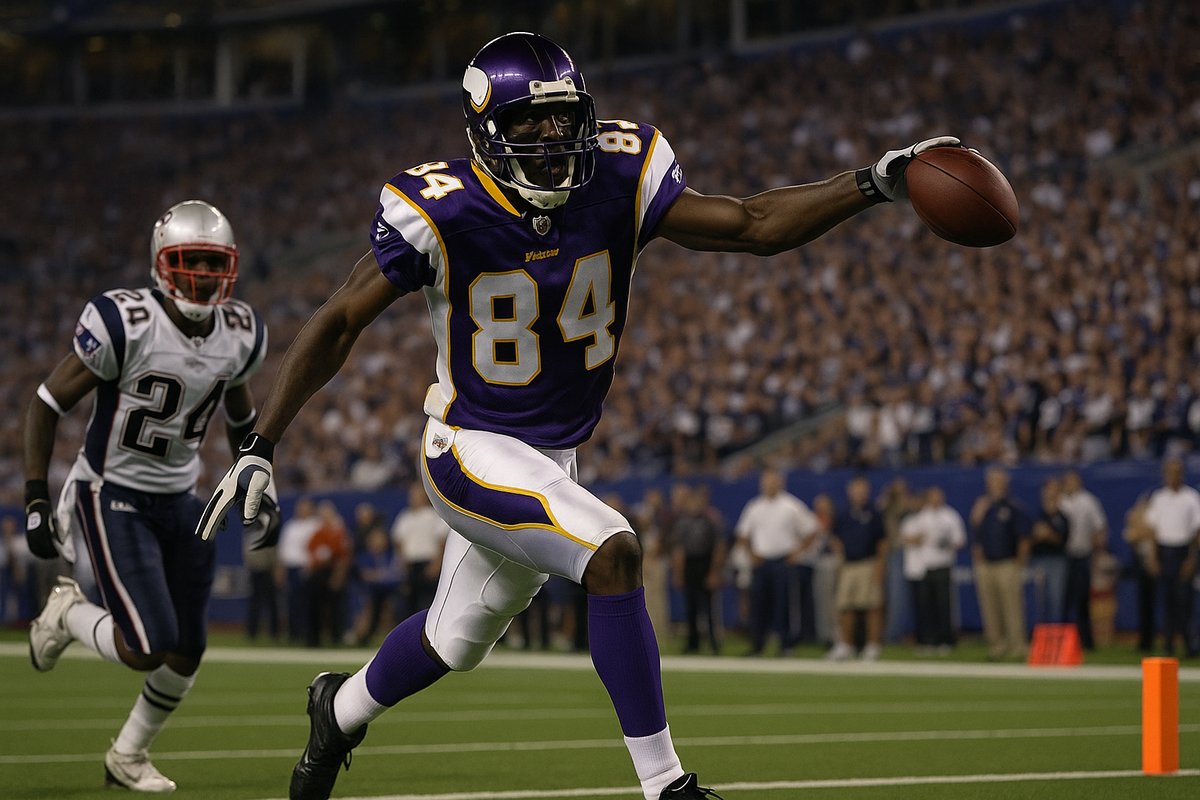
Randy Moss didn’t just run routes—he detonated them. When you’ve lined up in a defensive scheme as a linebacker tasked with helping over the top, you understand exactly how his combination of 4.3 speed and that ridiculous vertical leap turned single-high coverage into a liability. I’ve studied enough film to know that his rookie year with the Vikings wasn’t a fluke; those 69 catches for 1,313 yards and 17 touchdowns in 1998 forced every defensive coordinator to redraw their blueprints overnight.
Coming out of Marshall, West Virginia, Moss lit up the Thundering Herd with the same traits that later terrorized NFL secondaries. The off-field noise dropped him to the 21st overall pick in the 1998 draft, but Minnesota got a steal. From day one he stretched the field vertically, the kind of presence that makes linebackers and safeties hesitate on their run fits because one wrong step in gap discipline leaves you chasing a 60-yard bomb.
His prime, especially that 2007 stretch with the Patriots, is where the film really pops. Paired with Tom Brady, Moss posted 23 touchdown receptions, shattering Jerry Rice’s single-season mark. That 16-0 regular season was no accident—defenses had to commit extra bodies to the deep third just to keep him from running past everyone, which opened everything underneath for the rest of the offense. Five Pro Bowl nods and four First-Team All-Pro selections across stops in Oakland, Tennessee, and San Francisco only tell part of the story.
Over 14 seasons the numbers read like a clinic on vertical spacing: 982 receptions, 15,292 yards, 156 touchdowns, and a 15.6 yards-per-catch average that still ranks among the elite for high-volume receivers. He led the league in receiving touchdowns three times—1998, 2003, and 2007—and his arrival routinely turned average passing attacks into top-10 units. Quarterbacks like Daunte Culpepper and Brady benefited directly because Moss demanded attention that no single defender could provide without help.
What stands out on the tape is how he mentalized younger receivers while still dominating. The combination of natural ability and competitive fire created a presence that transcended statistics. Opposing defensive backs would often find themselves beaten before the snap, knowing they had limited chances to stay with a receiver capable of winning at multiple levels of the field. His ability to adjust mid-route and redirect his body in ways that seemed to violate basic physics gave him an edge that scouts couldn’t fully quantify until they saw it on tape.
The 2007 Patriots season deserves deeper examination because it represents the apex of what one receiver could accomplish within a cohesive offensive system. When Moss caught his 23rd touchdown reception against the New York Giants in Week 17, he wasn’t just breaking Rice’s record—he was announcing that the deep threat position had evolved. He finished that season with 98 catches and 1,493 yards, establishing himself as the first receiver to simultaneously lead the league in both touchdowns and receiving yards while maintaining that elite yards-per-reception average. The Patriots’ offense that year wasn’t built around gimmicks; it was built around the fundamental principle that Moss could beat any coverage, anywhere on the field.
His journey through multiple franchises tells another story about adaptability. After his dominant years in Minnesota, the receiver transitioned to Oakland, where he posted consecutive 1,000-yard seasons despite quarterback instability. When injuries and age began catching up to him in Tennessee, he still found ways to contribute. His final stop in San Francisco showcased a veteran’s intelligence, taking shorter routes and using savvy releases rather than relying solely on the physical tools that made him famous. This willingness to evolve his game extended his career at a high level longer than many expected.
The statistics from his peak years paint a picture of sustained excellence that few receivers have matched. In 1998, his rookie season, that 17-touchdown output tied him with Elois Goad for the most recent rookie record before 2012. His 2003 season with the Vikings saw him post 111 catches for 1,632 yards and 17 touchdowns again, demonstrating that his rookie brilliance wasn’t a one-year phenomenon but rather the beginning of a generational talent. The consistency across different offensive systems—from Minnesota’s west coast principles to Oakland’s vertical schemes to New England’s precision passing attack—revealed a receiver whose skills transcended scheme dependency.
Defensive film study of Moss reveals why coaches considered him nearly undefendable in optimal conditions. He possessed the rare combination of elite-level quickness off the line, outstanding hands for a receiver his size, and an intelligence for reading coverage that allowed him to separate from defenders in ways that seemed impossible. His release moves were sudden and violent, giving cornerbacks no opportunity to establish position. Once into his route, the verticality was devastating—he could plant and explode upward with a 38-inch vertical leap that allowed him to go up and over defensive backs rather than around them.
Post-retirement, the 2018 Hall of Fame induction simply confirmed what the film already showed: Moss changed how offenses attacked coverages and how defenses had to prepare. Offensive coordinators began to understand that having a legitimate deep threat required defensive adjustments that cascaded through entire game plans. Safety positioning became more complicated, corner blitzes became riskier, and two-high coverages became mandatory in certain situations. Teams that lacked a receiver of Moss’s caliber found themselves disadvantaged in critical moments.
The 2007 stat line alone—98 catches, 1,493 yards, 23 touchdowns—remains the blueprint for what a true deep threat can do when the scheme and quarterback are aligned. Modern receivers studying film will recognize the same principles that made Moss elite: relentless vertical demands, pristine route precision, and the mental ability to weaponize single coverage before it arrives. His career average of 15.6 yards per reception across 982 receptions demonstrates that this wasn’t a one-season anomaly but a sustained demonstration of offensive dominance.